LinkedIn has replaced its entire content ranking system with something fundamentally new. The platform launched 360Brew, a new AI-driven model that determines what appears in your feed, which posts gain traction and how professional relevance is defined.
This isn’t a small update or tweak to existing algorithms. For years, LinkedIn rewarded consistency, engagement speed and network size through separate ranking systems. 360Brew unifies them into one large-scale model that reads and interprets content more contextually, evaluating what’s being said and who it’s most relevant for. If you’ve noticed your posts performing differently, this change is the reason.
Both individuals and company pages have seen noticeable declines in reach and impressions. The feed is now more selective, showing fewer posts to smaller, more relevant audiences. Visibility depends less on frequency or timing and far more on topic alignment, expertise and the clarity of your ideas.
This shift has redefined how visibility, credibility and engagement are earned on the platform.
In this article
- The shift that changed LinkedIn
- How 360Brew works
- Why old tactics stopped working
- What’s changed inside the algorithm
- What this means for individual professionals
- What this means for companies
- How to adapt your LinkedIn activity
- What’s next for LinkedIn
- The bottom line
The shift that changed LinkedIn
360Brew is LinkedIn’s new foundation model that now powers everything you see and do on the platform, from your feed and job recommendations to ads and learning suggestions.
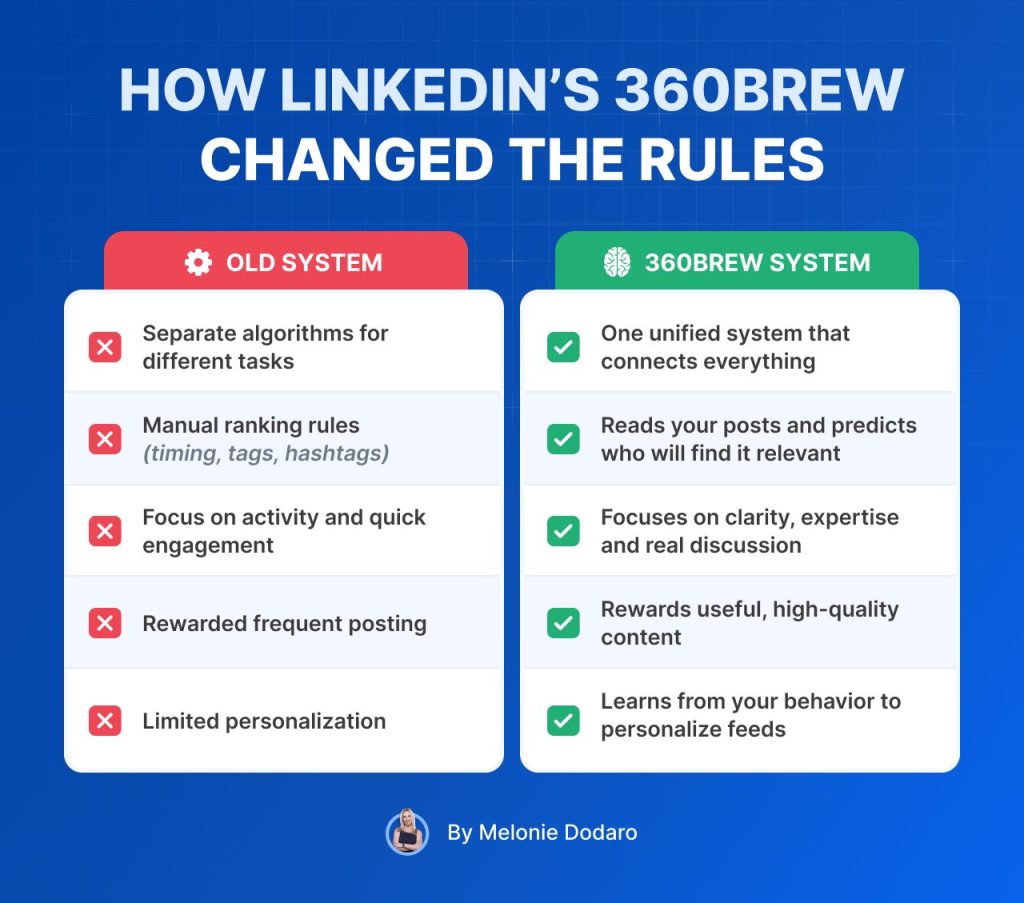
In the past, LinkedIn relied on many smaller algorithms, each focused on one task. One ranked posts, another recommended jobs, another suggested new connections. Each operated independently with its own set of rules.
360Brew replaces all of them with a single system that understands context and meaning across LinkedIn. It looks at how people communicate, what topics reflect their expertise and which audiences find that information relevant.
This change has made LinkedIn more selective about what appears in the feed. It no longer rewards posting frequency or engagement tricks. Instead, it prioritizes posts that are clear, relevant, and closely tied to your professional identity.
How LinkedIn’s 360Brew works
360Brew is built to understand professional communication: how people share insights, comment on ideas and connect through work-related conversations. It learns from how experts explain concepts, structure posts and engage with others across the platform.
When you publish a post, 360Brew reads both your profile and your content together. It looks at your headline, About section, skills and recent activity to understand your expertise. Then it reads your post as natural language, assessing how clearly you explain your ideas and whether the topic fits your professional focus.
The opening lines matter most. LinkedIn engineers describe this as the lost in distance effect: points that appear later in your post carry less weight. If your opening is weak or unclear, the post may not reach its full potential even if the rest is strong.
After publication, the system continues to learn from engagement patterns. It studies who interacts, how those interactions develop and what kind of comments appear. Posts that spark genuine conversation among credible professionals signal quality and stay visible longer. Quick reactions or generic comments contribute little.
Understanding how 360Brew reads your content explains why traditional tactics no longer work. The system no longer rewards activity for its own sake. It rewards clarity, relevance and meaningful discussion.
Why old tactics stopped working
The small tricks that once boosted visibility, such as posting at certain times, tagging long lists of people, or chasing quick reactions, no longer influence results. 360Brew now prioritizes whether your post has real value for the audience it reaches. It detects repetition, templated phrasing and engagement bait, and it reduces visibility when content feels forced or off-topic.
What performs best now is clear, useful writing that reflects your expertise. LinkedIn has shifted from rewarding volume to rewarding depth. Consistency still matters, but only when paired with substance.
Reality check on reach
Many professionals are seeing lower impressions, even on quality content. That does not mean their approach is wrong; it reflects a tighter, more selective feed. The algorithm now shows fewer posts to smaller, more relevant audiences.
To maintain visibility, focus on actions that prove your content is worth keeping:
- Start discussions that attract thoughtful comments.
- Create posts people want to save for later.
- Keep your topic narrow enough that the right audience instantly knows it is for them.
Posts that teach or clarify something useful stay in circulation far longer than those designed only to collect reactions.
What’s changed inside LinkedIn’s 360Brew algorithm
As LinkedIn’s 360Brew model reshapes what earns visibility, several behind-the-scenes changes are catching professionals and companies by surprise. These are five shifts worth understanding.
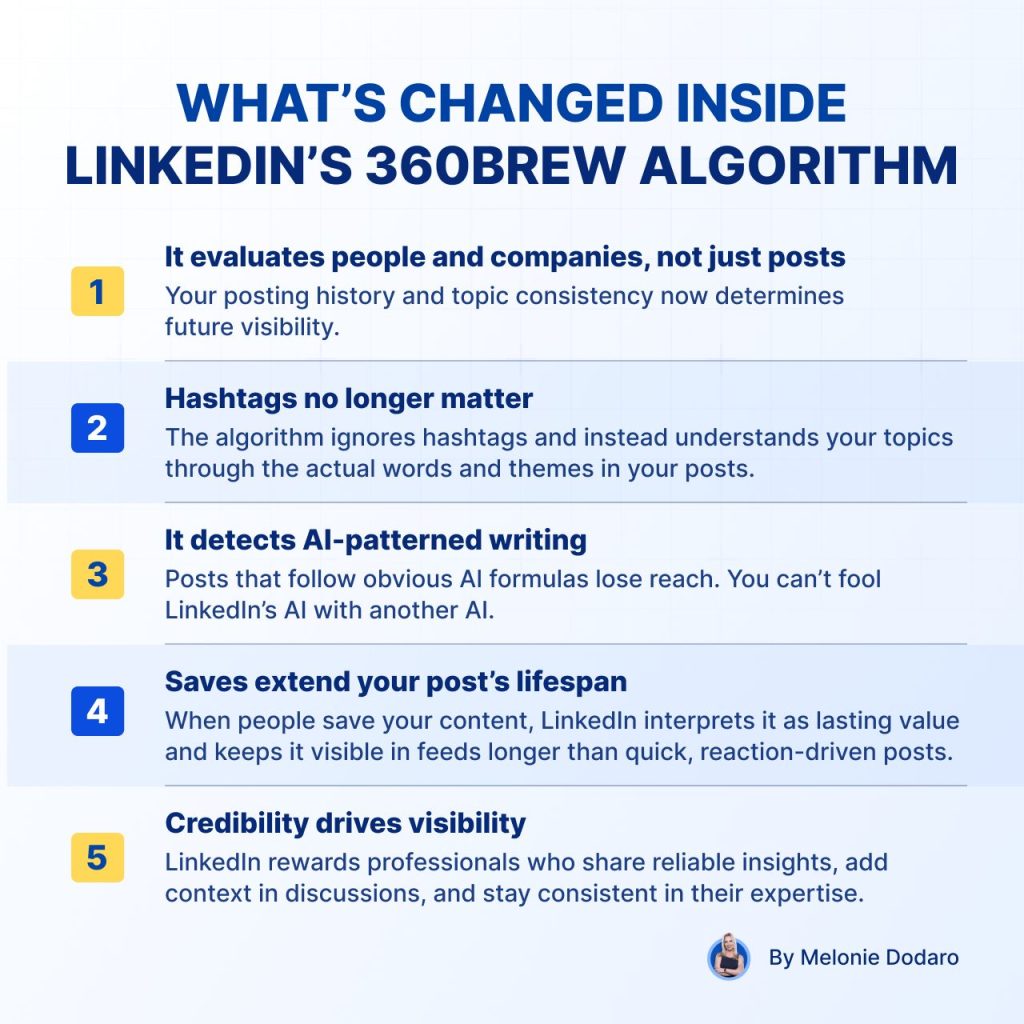
- LinkedIn now evaluates people and companies, not just posts. The algorithm no longer judges posts in isolation. It looks at the overall pattern of what you share and how consistently it aligns with your expertise. Your posting history now shapes how far future posts travel, which means long-term consistency matters more than ever.
- 2. Consistent topics build stronger visibility. Hashtags no longer play any role in distribution. Instead, LinkedIn analyzes the recurring themes in your content to understand what you regularly discuss and who finds it relevant. Individuals and companies that focus on two or three clear topics of expertise see more stable and targeted reach.
- 3. LinkedIn now detects AI-patterned writing. Posts that follow predictable AI structures or phrasing are easy for the system to spot. If your content reads like it came from a template rather than your own experience, visibility will drop. Use AI for outlining or brainstorming ideas, but always rewrite in your own words so your posts sound genuinely human.
- 4. Saves now signal long-term value. When people save your post, LinkedIn interprets it as content worth revisiting. Saved posts remain visible in feeds longer than quick, reaction-driven content. Both individuals and company pages benefit from this, although only individuals can currently see how many people have saved their content.
- 5. LinkedIn tracks credibility through behavior. The system gives more visibility to professionals and organizations that consistently share reliable insights and participate meaningfully. It evaluates not only what you post but how you engage. LinkedIn rewards those who add value in discussions, contribute useful context, and stay consistent in their expertise.
What this means for individual professionals
Treat every LinkedIn post as a small, focused insight that helps your audience understand something about your field. The system looks for alignment between what you write and what your profile says you do.
If your headline says Energy Transition Specialist but your posts focus on productivity hacks or lifestyle habits, the algorithm reads that as off-topic and limits distribution. When your content reinforces your area of expertise through lessons, analysis or commentary, it builds a pattern of credibility that steadily expands your visibility to the right audiences.
Your engagement habits teach the system just as much as your own posts. The content you like and comment on defines your professional circle. Regular interaction with credible voices in your field signals that you belong in those discussions. Over time, this helps your own posts appear in similar networks where your insights are most relevant.
How to post effectively under the new algorithm
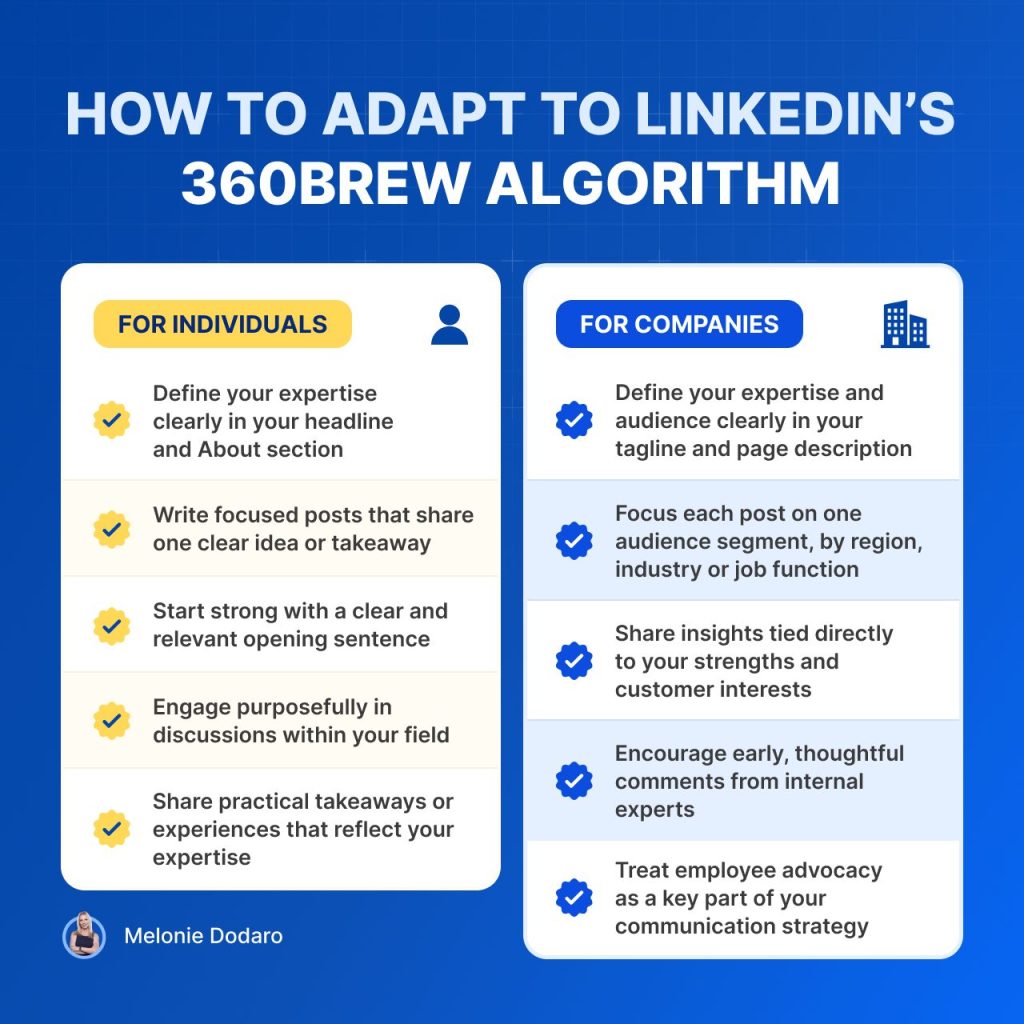
- Choose topics that directly support your expertise and reflect what your headline promises.
- Write clearly and skip filler or buzzwords; explain one idea well instead of several vaguely.
- Encourage meaningful discussion through thoughtful questions or reflections.
- Post consistently rather than constantly. One or two strong posts per week are enough to stay visible.
- Share practical insights or observations from your own experience to make your content feel credible and relevant.
What this means for companies
Company pages now face a tougher environment for organic visibility. The 360Brew model favors relevance above all else, showing fewer posts to smaller, more specific audiences. As a result, even high-quality company posts are seeing lower impressions and engagement than before. This shift is platform-wide, not performance-specific. It reflects LinkedIn’s move toward a more selective, interest-driven feed.
To succeed in this new environment, clarity of focus matters most. The algorithm looks for consistency between what a company says it does and the topics it publishes about. Pages that mix unrelated themes or post primarily promotional content lose traction quickly. Pages that share insights tied directly to their expertise continue to earn visibility among audiences that care about those topics.
If your organization serves multiple industries, sectors, or regions, it is now essential to target your content deliberately. Avoid broad, one-size-fits-all updates. A post written for everyone often reaches no one. Instead, tailor each post to a single audience segment, by geography, industry and/or job function. When posts reach the wrong audience, the algorithm quickly learns they’re irrelevant and future visibility declines.
Your company description and tagline play a larger role than many realize. They act as signals of expertise, helping the system understand what your organization represents. When your page content consistently supports those signals, LinkedIn recognizes your company as a credible voice and extends your reach to professionals with matching interests.
Visual content still matters, but not in the old “boost engagement” sense. Images and carousels perform best when they clarify or illustrate your point, not when they serve as attention bait. The accompanying text should explain what the visual shows and why it is useful. That clarity strengthens both comprehension and reach.
Early engagement from credible employees remains one of the most effective visibility triggers. When internal experts leave thoughtful comments within the first hour, it shows the system that genuine discussion is happening around your post. Short, generic remarks such as “great post” add little. Comments that expand on the idea or share an example help extend reach far more effectively.
How companies can stay visible under 360Brew
- Refine your company description and tagline so they clearly state your expertise and target audience.
- Choose two or three focus areas that reflect your organization’s real strengths and customer interests.
- Create audience-specific posts for each sector or region instead of publishing generic updates.
- Use carousels, charts or visuals to simplify data or illustrate learning points.
- Build an internal advocacy routine so that experts and employees know when and how to engage with new posts. Early, thoughtful comments remain the strongest signal of credibility and help extend reach far beyond a company’s follower base.
- Review engagement quality, not just quantity. Track who is commenting, whether they match your target audience, and which topics consistently attract meaningful discussion.
Organic visibility for company pages will not return to earlier levels. The feed is now more selective, and posts compete with paid ads and individual creators who naturally earn higher engagement. But influence is still within reach for companies that adapt. The most effective approach is to turn employees into credible advocates who extend the company’s voice into relevant professional networks.
Employee advocacy should now be treated as an essential part of your communication strategy. Equip teams with clear guidance on how to comment constructively, share posts in their own words and add perspective drawn from their expertise. Genuine participation from internal experts does far more to build reach and trust than any scheduling tactic or algorithm workaround.
How to adapt your LinkedIn activity
Key actions for individuals:
- Review your headline and About section so they clearly describe your area of expertise and who your content is for.
- Write posts that open with a clear point, expand with useful context, and close with reflection or a call for discussion.
- Use the first two sentences to make your topic instantly clear; the opening still carries the most weight in reach.
- Engage regularly on posts within your field to reinforce your professional focus and stay visible to the right networks.
- Post consistently rather than frequently. One or two thoughtful posts per week are enough when they genuinely add value.
- Keep your writing focused on clarity and usefulness. Avoid filler and buzzwords and aim to teach or clarify one idea at a time.
Key actions for companies:
- Keep your page description and tagline sharply defined around your expertise and audience focus.
- Choose a few recurring themes that align with your organization’s strengths and customer interests.
- Create audience-specific content for each sector or region you serve instead of broad corporate updates.
- Use visuals to explain your insights, charts, diagrams and carousels that make ideas easier to understand.
- Coordinate with internal experts before posting. Ask them to add early, thoughtful comments that expand on the message or share an example.
- Treat employee advocacy as a standing practice, not a one-time push. Consistent participation from credible voices strengthens both reach and trust.
These habits shape what LinkedIn engineers call your activity pattern, the consistent signals that show what you know, who you engage with, and how you contribute to your field. Over time, these patterns determine who sees your content and how far it travels.
What’s next for LinkedIn
The rollout of 360Brew marks a permanent change in how LinkedIn evaluates and distributes content. The model will continue to evolve toward cross-modal understanding, where post text, slides and visual content are interpreted together to assess relevance and quality. Consistency across all elements of a post will become increasingly important. What you write and what you show need to reinforce the same clear message.
Future updates will likely refine how credibility and interaction quality are measured. Posts that earn thoughtful comments and get saved for later reference already carry more weight than those that attract quick likes or surface-level reactions. The platform is shifting from rewarding visibility hacks to rewarding clarity, originality and usefulness.
Organic reach for both individuals and companies has tightened, and that trend is unlikely to reverse. Yet the opportunity remains strong for those who adapt. Visibility now depends on how well you align your expertise with your audience and how consistently you communicate ideas that matter to them.
The bottom line
360Brew has made LinkedIn more selective. It rewards clear thinking, practical insights, and genuine engagement rather than frequency or formulas. Professionals who simplify complex ideas and contribute meaningfully to discussions will continue to build reach and influence.
For companies, sustained visibility will come through focus, credible employee participation, and precise audience targeting. Employee advocacy and topic relevance are now essential to growth.
LinkedIn’s feed has become more competitive, but also more rewarding for those who communicate with purpose. Success now comes from understanding your audience, writing with intent and sharing insights that help others do their work smarter. Clarity, consistency and value define the new standard for visibility under 360Brew.